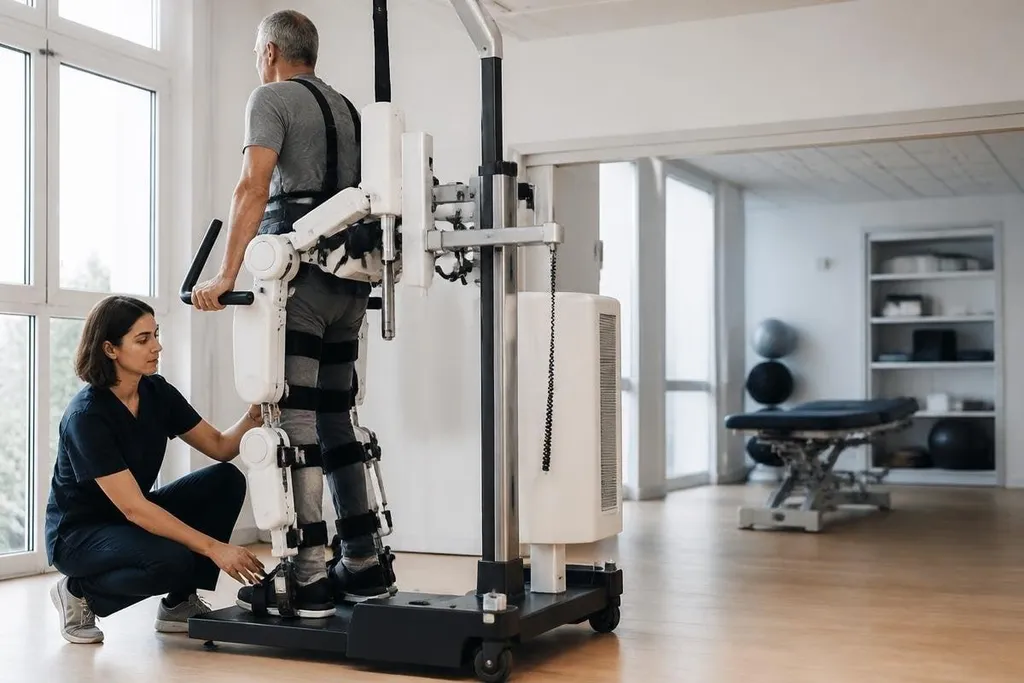
A rehabilitation robot can guide a leg, support an arm, or help a patient repeat a movement. The hard part is showing that the machine improves recovery outside a controlled session, where pain, fatigue, balance, and human care all affect the result.
Quick read:
- Repeated movement matters only when the patient can take part safely.
- A robot should show changes in walking, reach, strength, or daily tasks.
- The missing facts are often trial results, long-term use, and total cost.
What these robots actually do
Rehabilitation robots apply controlled support during a task. An exoskeleton can assist leg movement, while a robotic arm can guide reaching or help hold an arm against gravity. The machine may use sensors to read position, force, or speed, then adjust the help during the exercise.
That adjustment matters because a patient may need more help at the start of a session and less help as control returns. Too much support can remove the work the patient needs to do. Too little support can make the task unsafe or too tiring to repeat.
The useful measure is not how smoothly the robot moves. It is what the patient can do after training. A trial should report changes in walking distance, step timing, arm reach, grip force, or a named daily task, with the test method explained clearly.
Why the race is hard to judge
The field includes several kinds of machines, so one headline number rarely tells you much. A treadmill system, a wearable exoskeleton, and a robotic hand may all support rehabilitation, yet they address different movements and patient groups.
The same device can also produce different results under different care plans. Session length, training frequency, therapist input, and the patient’s starting condition all shape the outcome. A claim about one group cannot be moved to another without new evidence.
Price adds another problem. The purchase cost is only one part of the bill.
A clinic may need staff training, room changes, maintenance, software support, and time for a therapist to set up each session. If those details are missing, a cost comparison has a large gap.
A rehabilitation robot’s price needs a named trial beside it. On Robot 24, look for the machine, clinic, session length, and result before judging what it adds to a therapist’s work.
The proof that matters
A strong report should connect the robot’s design to a patient result. It should say who used the machine, what movement they trained, how long the program lasted, and what changed afterward.
The control group matters too. If patients using the robot improve, the result may still come from regular therapy, extra attention, or natural recovery. A comparison with standard care helps show what the machine added.
Long-term use is another test. A short study may show that a patient can complete a session. It may not show if clinics can run the system every day, if patients keep using it, or if the gains remain after the program ends.
No evidence pack was supplied for this article, so no company, trial, price, date, or named researcher can be assessed here. That limit matters: a global market map needs source material, not a list of assumed leaders.
A buying guide for clinics
Before a clinic gives serious attention to a rehabilitation robot, check these points:
- Patient fit: Name the movement, condition, and stage of recovery the system supports.
- Measured result: Ask for a trial result tied to walking, reach, strength, balance, or a daily task.
- Therapist time: Record setup, supervision, cleaning, and staff training for one session.
- Safety controls: Check the emergency stop, force limits, support settings, and failure response.
- Full cost: Add hardware, service, software, training, room changes, and replacement parts.
- Follow-up: Ask how long patients were checked after training ended.
I'd judge a rehabilitation robot by the patient’s lasting change, not by the machine’s smoothest video. A polished demo can show that the hardware moves; it cannot show that a person walks farther six months later.
The next useful comparison will need named systems, published trial results, prices, and clinic data. Until those details are available side by side, the race is easier to describe than to rank.